- A refraction test is essentially how your eye doctor figures out the exact prescription you need for glasses or contact lenses. It’s the part of your eye exam where they measure how light bends in your eye to pinpoint issues like nearsightedness, farsightedness, or astigmatism. Think of it as finding the perfect lens to help you see the world clearly.
What a Refraction Test Is, Plain and Simple
Ever wondered how your eye doctor magically knows what strength your glasses should be? That’s where the refraction test comes in. It’s a fundamental part of an eye exam designed to nail down the precise eyeglasses or contact lens prescription you need to see your best.
Defining Refraction and Its Purpose
At its core, “refraction” refers to how light bends as it passes through your eye. Your cornea and lens are responsible for focusing this light onto your retina. If the light doesn’t focus correctly, your vision becomes blurry. The refraction test’s main purpose is to measure exactly how much correction is needed to make that light land perfectly on your retina. It’s not just about seeing better; it’s about achieving your best possible vision.
Distinguishing Refraction from a Comprehensive Eye Exam
It’s important to understand that a refraction test, while crucial, is only one piece of the puzzle during a comprehensive eye exam. Think of it this way: the refraction test helps determine the power of the lenses you need for clear vision. A full eye exam, however, goes much deeper. It involves checking your overall eye health, looking for signs of eye diseases like glaucoma, cataracts, or macular degeneration, and assessing things like eye pressure, peripheral vision, and the health of your optic nerve. So, while refraction figures out your prescription, the full exam looks after the health of the entire eye.
A refraction test is a crucial procedure used to determine an individual’s prescription for glasses or contact lenses, helping to assess how light is focused in the eye. For those interested in learning more about eye care and vision correction, you can explore a related article that discusses various eye tests and their importance in maintaining optimal eye health. Check it out here: SmilePro Blog.
The Science Behind Your Clear Vision
The reason you might need glasses or contacts boils down to how light is bending (or misbending) in your eye. The refraction test zeroes in on these optical quirks.
Identifying Refractive Errors
Your eye is like a natural camera. For you to see clearly, light needs to focus directly on your retina, which is the light-sensitive tissue at the back of your eye. If the shape of your eye, cornea, or lens causes light to focus either in front of or behind the retina, or unevenly, that’s a refractive error. The refraction test is specifically designed to identify these errors.
Common Types of Refractive Errors
There are three main types of refractive errors that this test helps to diagnose:
- Nearsightedness (Myopia): This happens when light focuses in front of the retina. Distant objects appear blurry, while close-up objects remain clear. If you find yourself squinting to read road signs or see the TV, this might be you.
- Farsightedness (Hyperopia): In this case, light focuses behind the retina. Close-up objects appear blurry, and sometimes even distant objects can be fuzzy, especially with higher degrees of farsightedness. Reading small print might be a challenge.
- Astigmatism: This is a bit different. It occurs when your cornea (the clear front part of your eye) or lens has an irregular, football-like curve rather than a perfectly spherical shape. This causes light to focus at multiple points, leading to distorted or blurred vision at all distances. Things might look stretched or shadowy.
By precisely measuring these errors, the refraction test allows your eye doctor to prescribe lenses that correct how light enters your eye, bringing everything back into sharp focus on your retina.
How the Test Actually Works
If you’ve had an eye exam, you’ve probably experienced this part. It’s pretty straightforward and doesn’t involve anything invasive.
The Phoropter and Trial Lenses
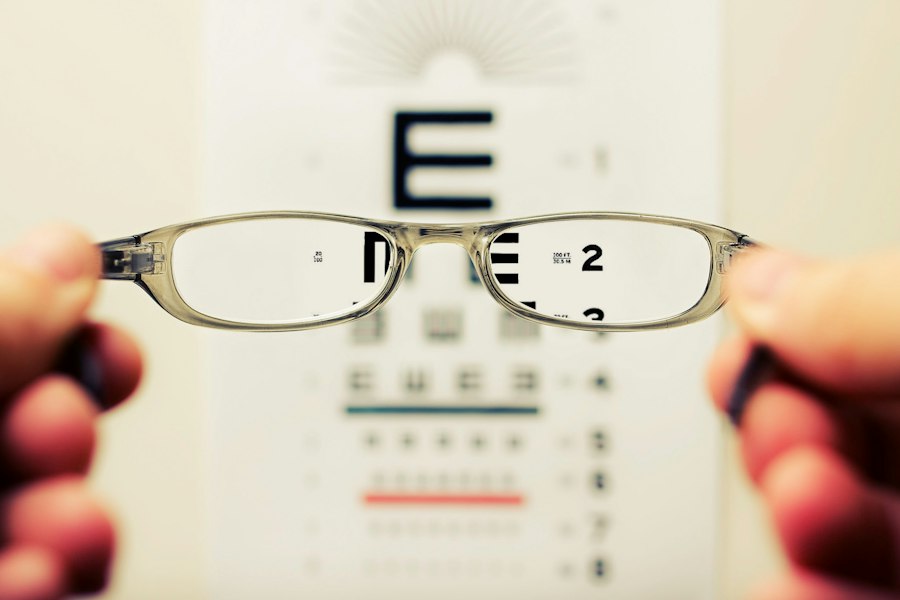
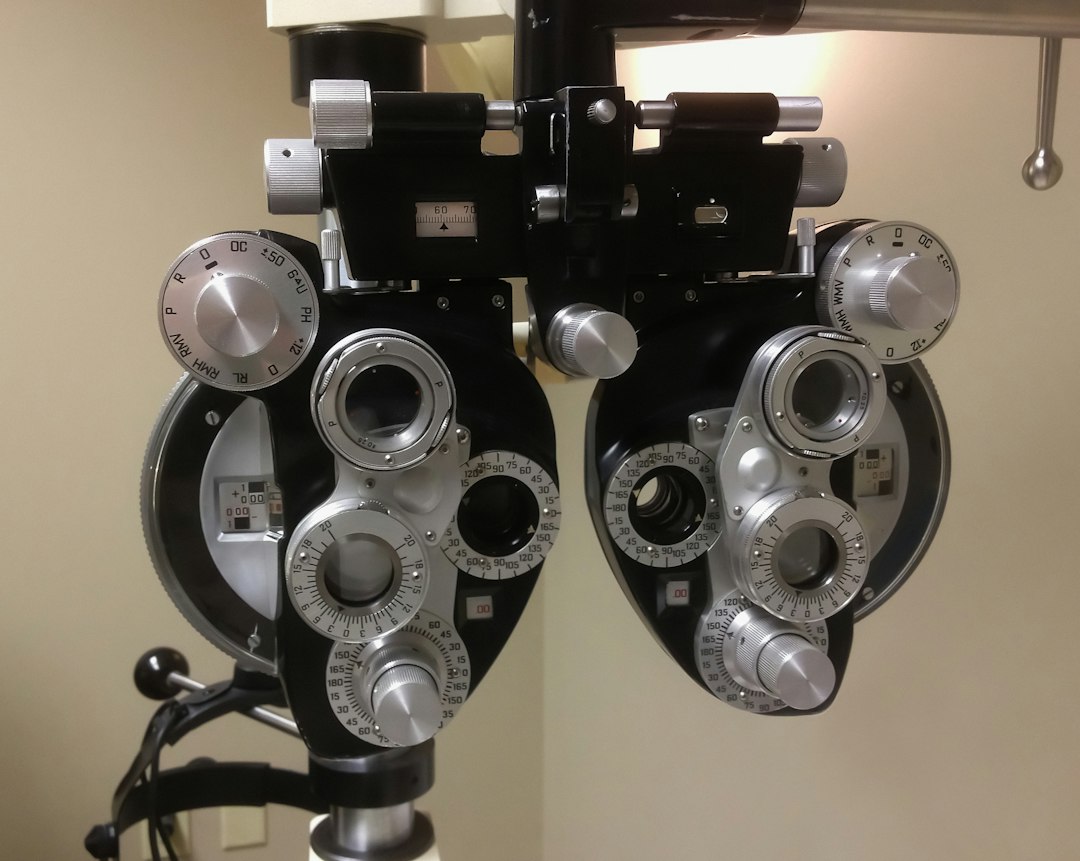
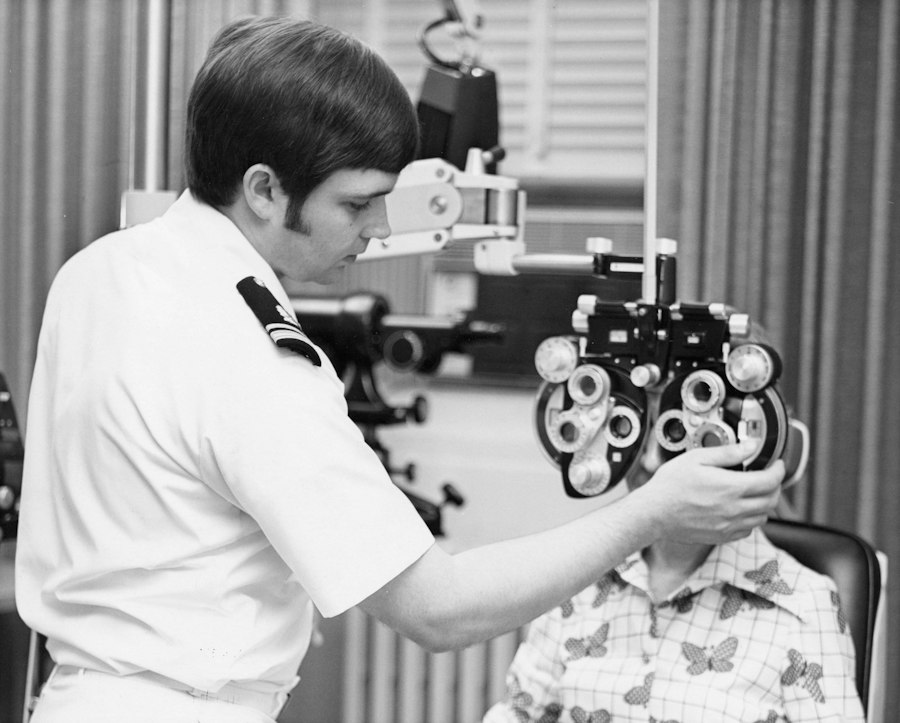
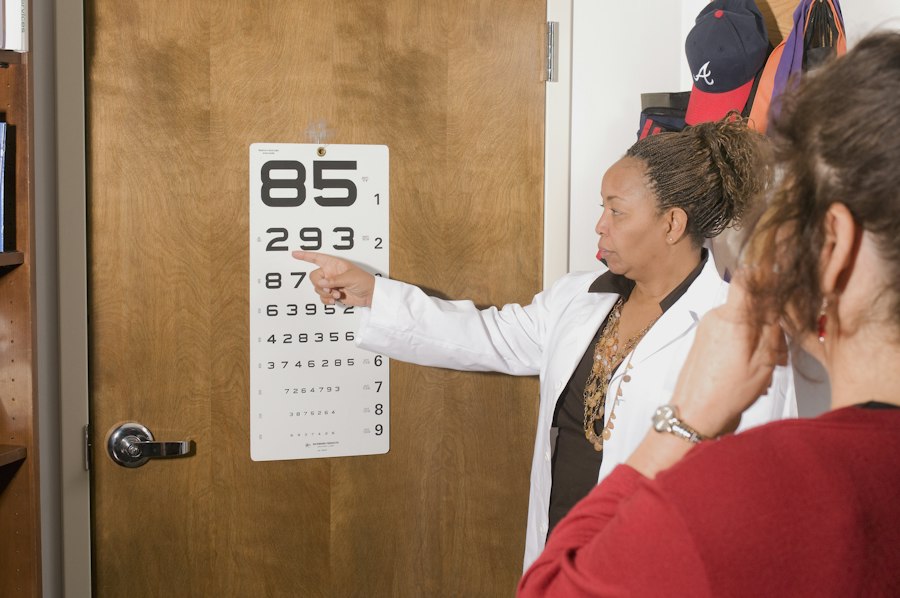
The most recognizable part of a refraction test usually involves a piece of equipment called a phoropter. This is that large, often intimidating-looking device with many lenses and dials that the doctor places in front of your face. You’ll look through it at an eye chart, typically across the room.
The eye doctor will then switch between different lenses, asking you questions like, “Which looks clearer, option one or option two?” or “Is this better, or this?” They’re fine-tuning the lens power based on your responses, slowly zeroing in on the prescription that gives you the sharpest vision.
Sometimes, especially for people with very high prescriptions or when fitting contact lenses, the doctor might use trial lenses. These are individual lenses that are placed into a special frame on your face. It’s essentially the same principle as the phoropter, just done manually. This allows the doctor to let you walk around a bit with the lenses, giving you a real-world feel for the prescription.
Objective Measurements: Autorefractors and Retinoscopy
Before the “which is better?” part, your eye doctor might use some tools to get an initial, objective measurement. These methods don’t rely on your subjective answers, making them especially useful for children, people who have difficulty communicating, or as a starting point for adults.
- Autorefractor: This is a computerized machine that you look into, often at a picture or a light. It automatically measures how light reflects off your retina and calculates an approximate prescription. It’s quick and provides a good baseline for the doctor.
- Retinoscopy: In this technique, the eye doctor shines a light into your eye and observes how the light reflects off your retina. By sweeping the light across your eye and neutralizing the reflection with different lenses, they can objectively determine your refractive error. This is a skilled technique often used as a cross-check or when a patient cannot verbally respond.
These objective measurements provide a solid starting point, which the doctor then refines with your feedback using the phoropter or trial lenses. This combination ensures the most accurate and personalized prescription.
Decoding Your Prescription: What the Numbers Mean
Once the test is done, you’ll get a prescription with a series of numbers and abbreviations. Don’t worry, it’s not ancient hieroglyphs. Understanding these terms helps you grasp what your lenses are actually doing.
Sphere, Cylinder, and Axis
These three terms are the core of most eyeglass and contact lens prescriptions:
- Sphere (SPH): This number indicates the main power of the lens needed to correct nearsightedness or farsightedness. It’s measured in diopters.
- A minus (-) sign before the number means you are nearsighted (myopic). The higher the number, the stronger the correction needed.
- A plus (+) sign (or sometimes no sign, implying plus) means you are farsighted (hyperopic). Again, a higher number indicates a stronger correction.
- If you have ‘PL’ or ‘0.00’, it means you don’t need spherical correction for that eye.
- Cylinder (CYL): This number indicates the lens power needed to correct astigmatism. It’s always accompanied by an axis.
- If there’s no number here or it’s ‘0.00’, you don’t have astigmatism.
- The cylinder power can be either positive (+) or negative (-), depending on the convention used by the doctor or lab.
- Axis: This number is always present if there is a cylinder value. It’s a number between 1 and 180 degrees and indicates the orientation or direction of the astigmatism on the cornea. Think of it like a clock face – it tells the optician where to orient the cylindrical power on your lens to correct the specific curve of your eye. Without the correct axis, the cylinder correction wouldn’t be effective.
Understanding the “ADD” Power
For people who need help with both distance and near vision (typically those over 40 experiencing presbyopia), you might see an “ADD” value on your prescription.
- ADD (Addition): This stands for “added magnifying power” and is the extra magnifying power applied to the bottom part of multifocal lenses (like bifocals or progressive lenses) to help with close-up tasks like reading. It’s always a positive number and is usually the same for both eyes. This value indicates how much additional power is needed for you to comfortably read or do other near work.
So, when you see a prescription that looks something like:
OD (Right Eye): -2.50 SPH -0.75 CYL x 180 AXIS ADD +1.75
OS (Left Eye): -2.00 SPH -1.00 CYL x 10 AXIS ADD +1.75
It means your right eye needs -2.50 for distance spherical correction, has -0.75 astigmatism at 180 degrees, and needs an additional +1.75 for reading. Your left eye has slightly different needs, but the same reading addition. Understanding these terms empowers you to discuss your vision needs more effectively with your optician.
A refraction test is an essential procedure used to determine an individual’s prescription for glasses or contact lenses, helping to correct vision problems. If you’re interested in learning more about the importance of eye health and various eye care procedures, you might find this article on eye care practices insightful. It provides valuable information that complements the understanding of tests like refraction. For more details, you can check out the article here.
Why This Test Matters (Beyond Just Getting Glasses)
| Aspect | Description | Typical Values/Range |
|---|---|---|
| Purpose | To determine the correct prescription for eyeglasses or contact lenses by measuring refractive error | N/A |
| Common Measurements | Spherical power, Cylindrical power, Axis of astigmatism | Spherical: -20.00 to +20.00 diopters Cylindrical: 0 to -6.00 diopters Axis: 0° to 180° |
| Test Methods | Objective refraction (autorefractor, retinoscopy), Subjective refraction (phoropter) | Objective: automated readings Subjective: patient feedback |
| Duration | Time taken to complete the test | 5 to 15 minutes |
| Age Range | Applicable age groups for refraction testing | All ages, including children and adults |
| Common Conditions Detected | Types of refractive errors identified | Myopia (nearsightedness), Hyperopia (farsightedness), Astigmatism, Presbyopia |
| Accuracy | Reliability of the test results | ±0.25 diopters |
While getting clear vision is the obvious benefit, the refraction test plays a larger role in your overall eye care.
A Quick, Painless, and Essential Step
One of the best things about a refraction test is that it’s generally very quick, simple, and completely painless. There are no drops involved in the refraction itself (though dilating drops might be used for other parts of the eye exam), no needles, and no discomfort. You just sit comfortably and answer a few questions. Considering how much crucial information it provides, it’s a remarkably easy process. It only takes a few minutes, yet it sets the foundation for your visual clarity for the next year or two.
Finding the “Best Vision” Prescription
Recent discussions in eye care coverage consistently highlight that the refraction test is the test that specifically pinpoints the lens power needed for your absolute best vision. It’s not just about “good enough”; it’s about optimizing your sight. Without this precise measurement, you could end up with lenses that still leave your vision slightly blurry or cause eye strain. The goal is to achieve 20/20 vision (or as close to it as your eyes can get) with corrective lenses.
Part of a Holistic Approach to Eye Health
As mentioned earlier, the refraction test is a vital component of a comprehensive eye exam, but it’s not the whole story. While it focuses solely on determining your corrective lens power, the broader exam encompasses a much wider range of assessments. This includes checking for signs of eye diseases like glaucoma, cataracts, diabetic retinopathy, or macular degeneration, which often have no early symptoms but can lead to irreversible vision loss if left untreated. Your eye doctor will also check your eye pressure, examine the health of your retina and optic nerve, and assess your peripheral vision.
So, while getting your prescription is a great immediate benefit, remember that the refraction test also serves as a gateway to ensuring your eyes are healthy overall. It’s a powerful tool in preventing potential vision problems down the line by prompting a full and thorough examination of your ocular health.
FAQs
What is a refraction test?
A refraction test is an eye exam that measures a person’s prescription for eyeglasses or contact lenses. It determines the amount of refractive error a person has, such as nearsightedness, farsightedness, or astigmatism.
How is a refraction test performed?
During a refraction test, the eye doctor will ask the patient to look through a phoropter and read letters on a chart at a distance. The doctor will then test different lenses to determine which ones provide the clearest vision for the patient.
Who should have a refraction test?
Anyone experiencing vision problems, such as blurry vision, difficulty reading, or eye strain, should consider having a refraction test. It is also recommended for individuals who have not had an eye exam in over a year.
Is a refraction test the same as a comprehensive eye exam?
No, a refraction test is just one part of a comprehensive eye exam. While a refraction test determines the prescription needed for glasses or contacts, a comprehensive eye exam also includes tests for eye health, eye coordination, and eye diseases.
How often should a refraction test be done?
It is recommended to have a refraction test done every one to two years, or as advised by an eye care professional. Regular eye exams are important for maintaining good vision and overall eye health.